Skip to content
What Happens If Fuel Tanks Aren't Labelled Properly?

Introduction
An unlabelled or incorrectly labelled fuel tank isn't just a compliance issue — it's a safety risk that can result in serious injury, fire, environmental damage, and significant fines under Australian workplace health and safety law.
Yet many businesses — particularly small operators, farms, and construction sites — still run fuel storage without proper identification. Here's what's actually at stake.
The Legal Requirement
In Australia, fuel tank labelling is required under:
- Work Health and Safety Act 2011 (Commonwealth and state equivalents) — requires hazardous chemicals to be correctly identified at all times
- AS1940:2017 — The Storage and Handling of Flammable and Combustible Liquids
- Work Health and Safety Regulation 2011 — placarding requirements for hazardous chemicals above threshold quantities
Failure to comply isn't a grey area. Regulators including WorkSafe Queensland, SafeWork NSW, and WorkSafe Victoria have the authority to issue improvement notices, prohibition notices, and fines.
What Can Go Wrong Without Proper Labels?
1. Misfuelling
Without clear identification, workers can accidentally fill diesel equipment with petrol or vice versa. Misfuelling can cause catastrophic engine damage and, in some cases, fire. On a mining or construction site, this can take a vehicle or generator out of service at significant cost.
2. Fire and Explosion Risk
Emergency responders attending an incident need to know immediately what's stored in a tank. An unlabelled tank delays their response and increases the risk of the wrong suppression method being used — potentially making a fire worse.
3. Environmental Damage
A spill from an unlabelled tank complicates emergency response and cleanup. Environmental regulators can pursue separate penalties for spills that weren't properly managed, on top of WHS fines.
4. Worker Injury
Workers handling fuel without knowing the contents, flash point, or hazard classification are at increased risk of burns, inhalation, or chemical exposure. This creates direct liability for the business owner.
5. Regulatory Fines
WHS regulators can issue on-the-spot fines for unlabelled hazardous chemical storage. In serious cases, prosecutions under the WHS Act can result in penalties of hundreds of thousands of dollars for businesses and individuals.
What Labels Are Required?
At minimum, a compliant fuel tank should display:
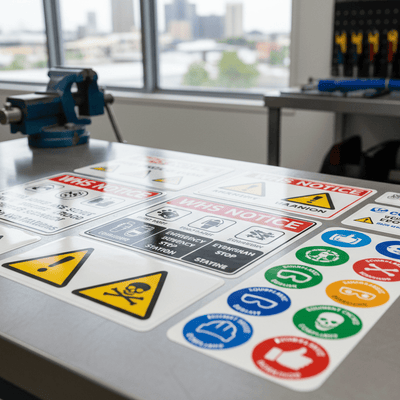
- Product name — e.g. Diesel Fuel Tank Sticker clearly identifying contents
- Hazard classification — Flammable Liquid Class 3 diamond where applicable
- Tank capacity — Safe Fill capacity label in litres
- Function identification — dip, fill, vent and emergency labels on all access points
- Safety warnings — including Do Not Weld or Drill where relevant
How Often Should Labels Be Replaced?
Labels should be replaced when they become:
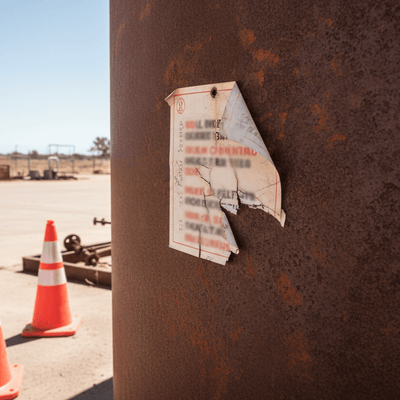
- Faded or illegible
- Peeling or lifting at the edges
- Damaged by fuel splashes or cleaning chemicals
- No longer accurate (e.g. tank repurposed for a different fuel)
Using quality 7-year outdoor vinyl fuel tank labels significantly reduces replacement frequency compared to cheap alternatives.
The Cost Of Compliance vs The Cost Of Non-Compliance
A complete set of fuel tank identification labels from Stick-Dat costs a fraction of what a single WHS improvement notice costs to rectify — let alone a fine or prosecution.
Compliance labelling is one of the lowest-cost risk management tools available to any business storing fuel.
Conclusion
Unlabelled fuel tanks put workers at risk, expose businesses to significant legal liability, and complicate emergency response. Australian law is clear: hazardous chemical storage must be correctly identified at all times.
Browse our full range of fuel tank identification labels — all printed on 7-year outdoor vinyl, UV-resistant and waterproof, made in Brisbane for Australian conditions.