Skip to content
Hazardous Goods Sticker Classes Explained: Hazmat Labels Used in Australia

Hazardous goods (HAZMAT) labelling is a legal requirement in Australia under the Australian Dangerous Goods Code (ADG Code) for the transport, storage, and handling of dangerous materials. Missing or incorrect HAZMAT labels create serious risks: transport violations, workplace safety incidents, environmental contamination, and regulatory fines.
At Stick-Dat, we supply HAZMAT-compliant stickers for Australian businesses, transport operators, and industrial facilities handling dangerous goods. Whether you're transporting chemicals, storing flammable materials, or managing industrial hazards, the correct HAZMAT labelling protects workers, drivers, emergency responders, and the public.
Why HAZMAT Labelling Is Critical
Hazardous goods classification and labelling ensures that dangerous materials are correctly identified, handled, and transported according to Australian Standards. Clear, compliant HAZMAT stickers enable:
- Safe transport and storage of dangerous goods
- Quick hazard identification by emergency responders
- Compliance with ADG Code and workplace safety regulations
- Protection of workers, drivers, and the public
- Prevention of environmental contamination
- Proper emergency response procedures
Poor or missing HAZMAT signage can result in:
- Transport violations and vehicle impoundment
- Workplace safety incidents and chemical exposure
- Environmental damage and cleanup costs
- Regulatory fines and prosecution
- Insurance claim rejections
- Chain of Responsibility (CoR) breaches
Australian Dangerous Goods Classes Explained
The ADG Code classifies hazardous goods into 9 classes based on their primary hazard. Each class uses a specific diamond-shaped placard with distinctive colours and symbols:
Class 1 – Explosives
Orange diamond with exploding bomb symbol. Includes:
- Fireworks and pyrotechnics
- Ammunition and detonators
- Blasting agents and explosives
Subdivided into 1.1 (mass explosion) through 1.6 (extremely insensitive).
Class 2 – Gases
Diamond labels with gas cylinder symbol. Subdivided by hazard:
- Class 2.1 – Flammable Gas (Red): LPG, propane, butane, acetylene
- Class 2.2 – Non-Flammable, Non-Toxic Gas (Green): Oxygen, nitrogen, CO2, compressed air
- Class 2.3 – Toxic Gas (White): Chlorine, ammonia, hydrogen sulfide
Our LPG and gas safety stickers meet ADG Code requirements for Class 2 gases.
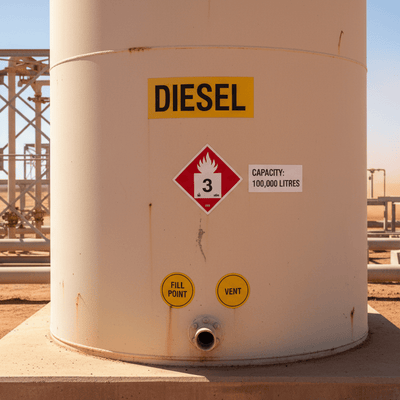
Class 3 – Flammable Liquids
Red diamond with flame symbol. Includes:
- Petrol, diesel, and aviation fuel
- Solvents and thinners
- Paints and adhesives
- Alcohols and spirits
Our Flammable Class 3 stickers and fuel tank identification labels are commonly used for Class 3 materials.
Class 4 – Flammable Solids
Red and white striped diamond. Subdivided into:
- Class 4.1 – Flammable Solids: Matches, sulfur, metal powders
- Class 4.2 – Spontaneously Combustible: White phosphorus, oily rags
- Class 4.3 – Dangerous When Wet: Sodium, calcium carbide
Class 5 – Oxidising Agents & Organic Peroxides
Yellow diamond with flame over circle symbol. Includes:
- Class 5.1 – Oxidising Agents: Hydrogen peroxide, pool chlorine, fertilizers
- Class 5.2 – Organic Peroxides: Benzoyl peroxide, MEK peroxide
Class 6 – Toxic & Infectious Substances
White diamond with skull or biohazard symbol. Subdivided into:
- Class 6.1 – Toxic Substances: Pesticides, cyanides, heavy metals
- Class 6.2 – Infectious Substances: Medical waste, biological samples, cultures
Related to our clinical and medical waste labelling for healthcare facilities.
Class 7 – Radioactive Materials
Yellow and white diamond with radiation trefoil symbol. Includes:
- Medical isotopes and radiotherapy materials
- Industrial radiography sources
- Nuclear medicine and research materials
Class 8 – Corrosive Substances
Black and white diamond with corrosion symbol. Includes:
- Acids (sulfuric, hydrochloric, nitric)
- Alkalis (caustic soda, sodium hydroxide)
- Battery acid and cleaning chemicals
Class 9 – Miscellaneous Dangerous Goods
Black and white striped diamond. Includes:
- Lithium batteries and power banks
- Dry ice (solid CO2)
- Asbestos and environmentally hazardous substances
- Magnetized materials
Where HAZMAT Stickers Must Be Displayed
Transport Vehicles
Vehicles transporting dangerous goods must display:
- HAZMAT placards on all four sides of the vehicle
- Emergency information panels (EIP) with UN numbers
- Class-specific diamond labels for the goods being carried
- Compliance with ADG Code transport requirements
See our vehicle safety stickers guide for fleet compliance.
Storage Areas & Facilities
Warehouses, depots, and storage facilities require:
- Class labels on storage containers and drums
- Storage area warning signs (e.g., "Flammable Liquids Storage")
- Segregation and compatibility signage
- Emergency response information
Workplace & Industrial Sites
Construction sites, factories, and industrial facilities need:
- Chemical storage cabinet labels
- Pipework and tank identification
- Hazardous area warnings
- Emergency equipment markers
Often used alongside construction site safety signage and first aid and emergency equipment markers.
Who Needs HAZMAT Stickers?
Our HAZMAT-compliant labels are used by:
- Transport and logistics companies
- Chemical manufacturers and distributors
- Mining and resources companies
- Industrial and manufacturing facilities
- Fuel suppliers and service stations
- Agricultural and farming operations
- Waste management and recycling facilities
- Construction and demolition contractors
- Medical and laboratory facilities
- Councils and government agencies
Built for Australian Compliance
All HAZMAT stickers in our range are:
- Printed on high-quality outdoor vinyl
- UV-resistant for long-term durability
- Suitable for metal, plastic, and painted surfaces
- Designed to withstand weather, chemicals, and handling
- Compliant with Australian Dangerous Goods Code
- Manufactured in Brisbane, Australia
Bulk Options for Industrial Operations
High-volume users benefit from bulk purchasing:
- Consistent HAZMAT labelling across all sites and vehicles
- Trade-friendly pricing for volume orders
- Fast turnaround for urgent compliance requirements
- Custom options for site-specific hazard identification
Why Choose Stick-Dat for HAZMAT Labelling?
- Australian made signage – manufactured in Brisbane, Australia
- Fast turnaround and shipping
- Trade-friendly pricing for industrial and transport operators
- Designed for real-world dangerous goods compliance
- Trusted by transport companies, industrial facilities, and safety professionals nationwide
Frequently Asked Questions
What is the difference between HAZMAT placards and labels?
Placards are large (250mm) diamond signs displayed on transport vehicles. Labels are smaller versions used on packages, drums, and containers. Both use the same class colours and symbols.
Do I need HAZMAT stickers for small quantities of dangerous goods?
Yes, in most cases. Even small quantities require proper labelling for safe handling, storage, and emergency response. Check the ADG Code for specific quantity exemptions.
Can I use the same HAZMAT stickers for transport and storage?
Yes. The same class diamond labels are used for both transport and storage, though transport vehicles also require placards and emergency information panels.
How do I know which HAZMAT class my chemicals belong to?
Check the Safety Data Sheet (SDS) for your chemical. It will specify the dangerous goods class, UN number, and labelling requirements.
Are HAZMAT stickers required for LPG vehicles?
Yes. LPG-converted vehicles must display Class 2.1 Flammable Gas red diamond stickers on the rear of the vehicle as per ADR requirements.
Related Compliance Collections
Complete your dangerous goods compliance signage:
- LPG & Gas Safety Stickers
- Fuel & Tank Identification Stickers
- Truck & Vehicle Safety Stickers
- First Aid & Emergency Stickers
Order HAZMAT Stickers Online
If you need compliant, durable HAZMAT stickers for transport, storage, or industrial use, browse our range of dangerous goods class labels:
👉 HAZMAT Products:
- Flammable Gas Class 2 Stickers
- Flammable Class 3 Stickers
- Toxic Gas Number 2 Stickers
- Toxic Number 6 Stickers
Whether you need stickers for one vehicle or bulk packs for industrial operations, Stick-Dat has a solution built for Australian dangerous goods compliance. Order today for fast dispatch across Australia.
Related Products
-
 "Try Me" Stickers – White Text on Red | Retail Product Decals | Australian Made
 -
 1 Meter long Get ya Snatch out Sticker vinyl cut 4x4 Decal long rude funny your
 -
 1.5 Meter long Get ya Snatch out Sticker vinyl cut 4x4 Decal long rude funny you
 -
 1.5 meters sticker vinyl cut Decal Aussie corona social distance distancing Bugs