Skip to content
The Best Sticker Material for Outdoor Australian Conditions

Introduction
Australia's climate is one of the harshest on earth for adhesive labels and stickers. Intense UV radiation, extreme heat, coastal salt air, and wide temperature swings can destroy cheap stickers within months.
Whether you need stickers for vehicles, equipment, fuel tanks, or workshop tools, choosing the right material from the start saves money and prevents compliance failures down the track.
Why Most Cheap Stickers Fail Outdoors
Budget stickers and labels typically use:
- Paper substrates — absorb moisture, fade quickly, and peel within weeks outdoors
- Low-grade vinyl — becomes brittle in UV and cracks within 1–2 years
- Water-based inks — fade rapidly in direct sunlight
- Weak adhesives — fail in heat above 60°C (common on vehicle surfaces in summer)
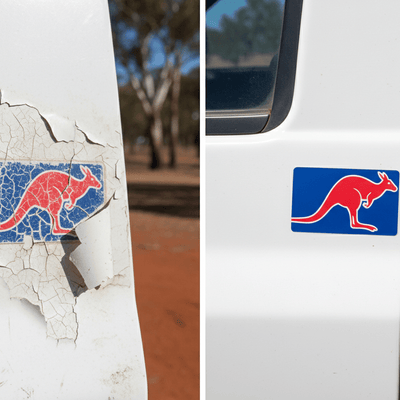
In Queensland and other high-UV states, a sticker on a vehicle or outdoor equipment can reach surface temperatures of 70–80°C on a hot day. Most cheap labels simply aren't built for this.
The Best Material: Cast Vinyl
For outdoor Australian conditions, cast vinyl is the gold standard. Here's why:
- Rated for 5–7 years outdoors in direct sun
- Flexible enough to conform to curved surfaces without cracking
- Resistant to UV degradation, moisture, and temperature extremes
- Holds colour and adhesion through repeated heating and cooling cycles
At Stick-Dat, all our outdoor stickers and labels are printed on 7-year outdoor cast vinyl — the same material used in vehicle wraps and industrial signage.
Calendered Vinyl vs Cast Vinyl
| Property | Calendered Vinyl | Cast Vinyl |
|---|---|---|
| Outdoor lifespan | 1–3 years | 5–7 years |
| UV resistance | Moderate | High |
| Flexibility | Stiffer | Highly flexible |
| Conformability | Flat surfaces only | Curves and rivets |
| Cost | Lower | Higher (worth it) |
For flat indoor applications, calendered vinyl is fine. For anything outdoors in Australia — especially vehicles, equipment, and tanks — cast vinyl is the only sensible choice.
The Role Of Laminate
Even the best vinyl benefits from a protective laminate layer. A UV-resistant gloss or matte laminate:
- Adds an extra barrier against UV and abrasion
- Protects printed colours from fading
- Makes the sticker easier to clean
- Extends outdoor lifespan by an additional 1–2 years
All Stick-Dat outdoor stickers include UV-resistant laminate as standard.
Adhesive Matters Too
The adhesive is just as important as the face material. For outdoor Australian use, look for:
- Permanent acrylic adhesive — maintains bond in heat up to 80°C+
- Solvent-resistant — important for fuel tank labels and workshop equipment
- UV-stable — won't yellow or degrade in sunlight
Best Applications By Material
- Vehicle stickers and decals — 7-year cast vinyl with laminate → Vehicle & Marine Stickers
- Workshop and compliance labels — 7-year cast vinyl, solvent-resistant → Workshop & Compliance Stickers
- Business and safety signage — cast vinyl or rigid substrate → Business & Compliance Stickers
- Fuel tank labels — cast vinyl with chemical-resistant adhesive → Fuel Tank Identification Stickers
How Long Should Outdoor Stickers Last?
As a general guide for Australian conditions:
- Paper labels: weeks to months
- Low-grade vinyl: 1–2 years
- Calendered vinyl: 2–3 years
- 7-year cast vinyl (no laminate): 4–5 years
- 7-year cast vinyl with UV laminate: 6–7+ years
Conclusion
If you're buying stickers for outdoor use in Australia, material choice is everything. A cheap label that fails in 12 months costs more in the long run than a quality cast vinyl sticker that lasts 7 years.
All Stick-Dat stickers are made from 7-year outdoor cast vinyl with UV-resistant laminate — designed and printed in Brisbane for Australian conditions. Browse our full range of outdoor vehicle stickers, workshop labels, and compliance signage.
Related Products
-
 "Try Me" Stickers – White Text on Red | Retail Product Decals | Australian Made
 -
 1 Meter long Get ya Snatch out Sticker vinyl cut 4x4 Decal long rude funny your
 -
 1.5 Meter long Get ya Snatch out Sticker vinyl cut 4x4 Decal long rude funny you
 -
 1.5 meters sticker vinyl cut Decal Aussie corona social distance distancing Bugs